

Prime Therapeutics President and CEO urges policymakers to evaluate drug supply chain incentives, encourage biosimilar competition
At Punchbowl News event, Mostafa Kamal shared how transparency rules alone won't make prescriptions more affordable
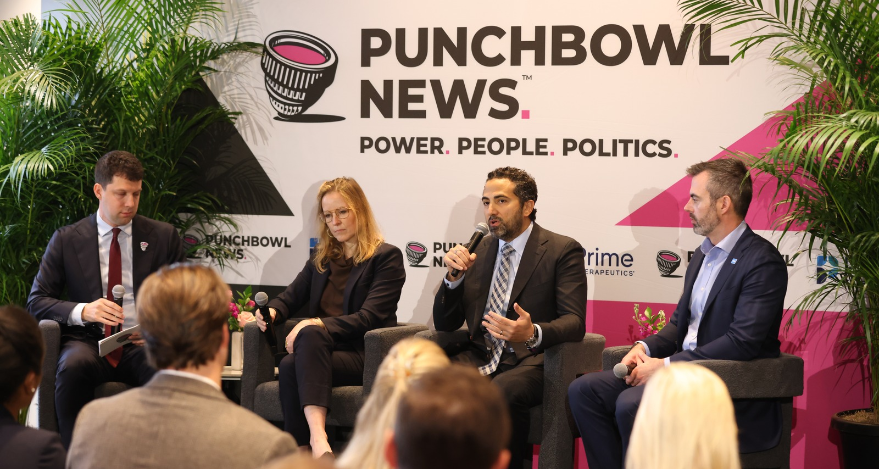
Transparency requirements alone will do little to lower what patients pay.
That was the central message that Prime Therapeutics (Prime) President and CEO Mostafa Kamal shared with a room of Capitol Hill staff, think tanks, policy experts and healthcare advocates at a recent Punchbowl News Newsmaker event: Congress should focus on patent reform, competition and the incentives built into the drug supply chain.
Kamal joined moderator Peter Sullivan (senior health policy reporter, Punchbowl News) and panelists Alex Keeton (executive director, Biosimilars Council) and Merith Basey (CEO, Patients for Affordable Drugs) to discuss prescription drug access and affordability at the November event held in partnership with Prime.
“We firmly believe that corporate structure and ownership create incentives, and incentives create decisions,” Kamal said. “There’s a fundamental difference in the way that Prime operates as a result of (our) ownership structure, which … gives us the flexibility and the freedom to create a set of decisions that drive toward affordability for both patients and the people who pay for their care.”
Incentives at the center
Policymakers should ask whether the organizations that handle prescription drugs are rewarded for the right outcomes, Kamal said.
For Prime, that answer starts with its ownership by not-for-profit Blue Cross Blue Shield plans. That structure means the value Prime generates flows back to the health plans, employers and patients it serves rather than to outside shareholders. As Kamal wrote in a RealClearHealth op-ed, in Prime's almost 30-year history, "not one dollar of value generated by Prime has gone to Wall Street investors." This structure also means Prime has no incentive to steer patients to Prime-owned pharmacies.
At the event, Kamal also cautioned against treating all pharmacy benefit managers (PBMs) as if they operate the same way. There are more than 65 PBMs in the United States, with a wide variety of ownership structures and business models. Much of the policy debate, however, focuses on PBMs that are part of publicly traded companies that also own pharmacies and health insurers. "We've kind of all centered around one business model that is not reflective of how this industry actually works," Kamal said.
Where the costs are
The bigger driver of drug costs, Kamal said, is what manufacturers charge for brand-name drugs — especially those without competition. Generics make up about 90% of prescriptions filled in the United States but only a small share of spending, while the remaining 10%, branded drugs, drives most of it. A May 2025 Reuters analysis found the median list price of new U.S. drugs launched in 2024 topped $370,000. Cell and gene therapies can reach even higher list prices.
Where a branded drug faces no competition, PBMs have limited tools to bring costs down. That's why Kamal sees competition, especially from biosimilars, as one of the most effective ways to help make prescriptions more affordable.
Stelara biosimilar case study
Kamal pointed to Stelara, a high-cost biologic for autoimmune conditions, as an example of how outdated rules can slow biosimilar adoption. Medicare drug plans lock in their formularies, or lists of covered drugs, about nine months before the plan year begins. After that, the Centers for Medicare & Medicaid Services (CMS) limits changes. When lower-cost Stelara biosimilars launched in 2025, plans had no clear way to add them. Kamal said those limits made sense before biosimilars existed, but when one becomes available, "you want to be able to get that on formulary."
Prime's Medicare team proposed that CMS allow plans to substitute Stelara biosimilars, showing the change could save patients and plans money without limiting clinically appropriate treatment options. CMS approved the substitution in 2025. In 2026, about 90% of Stelara users in the Medicare plans Prime serves switched to a biosimilar, and Prime estimates this substitution will save nearly $27 million this year.
Kamal tied the result back to incentives. "Many organizations don't have the incentive to … (make) that happen," he said.
Congressional priorities
Asked what message he would give lawmakers, Kamal said: "Address patent [thickets], increase competition, make it easier for biosimilars to be successful and examine the incentives that are driving decision-making around products and solutions across the entire supply chain of pharmaceutical drugs."
Patent thickets are clusters of overlapping patents on a single drug that can keep lower-cost competitors off the market long after the original patent expires. Humira, protected by more than 100 patents, faced biosimilar competition in Europe in 2018 but not in the United States until 2023.
Even after biosimilars reach the market, other barriers can limit their use. Pharmacists can routinely substitute a generic for a brand-name drug, but that generally isn't the case for biologics. Unless the U.S. Food and Drug Administration has designated a biosimilar as interchangeable and state law allows the swap, a patient typically needs a new prescription from their doctor to switch. Kamal said that requirement slows adoption. "That's friction," he said. "That's a barrier to the adoption of something that could actually save money."
All brand names are property of their respective owners.
About Prime Therapeutics

Prime Therapeutics LLC (Prime) is a diversified pharmacy solutions organization. We offer innovative pharmacy benefit management, specialty and medical drug management, and state government solutions to millions of people across the country. At Prime, we’re reimagining pharmacy solutions to provide the care we’d want for our loved ones. We challenge the way it’s always been done to develop intelligently designed solutions that deliver savings, simplicity and support to help people achieve better health. For more information, visit us at PrimeTherapeutics.com or follow us on LinkedIn.
Related Articles

Related Articles
Latest News
Login Portals
Compliance / Legal
Company